
High Chrome vs Manganese Blow Bars: Which is Better for Your Crusher?
Compare high chrome and manganese blow bars to understand which material is best for your crushing application, performance, and wear life.
CRUSHER WEAR PARTS
Melco Precisions Pvt Ltd
4/30/20262 min read
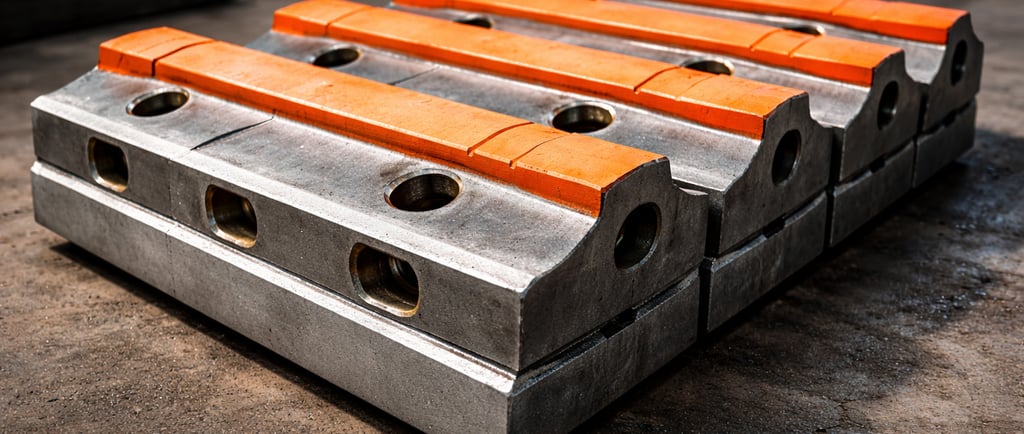
High Chrome vs Manganese Blow Bars: Which is Better for Your Crusher?
In crushing operations, selecting the right blow bar material is not just a technical decision, it directly impacts productivity, maintenance costs, and overall plant efficiency. Many operators struggle to choose between high chrome and manganese steel blow bars, especially when working with different types of materials and varying operating conditions.
Understanding how these materials perform in real-world applications can help you make a more informed and cost-effective decision.
What are High Chrome Blow Bars?
High chrome blow bars are manufactured using white iron with a high percentage of chromium. This composition gives them excellent wear resistance, making them ideal for applications where material abrasion is a major concern.
These blow bars are commonly used in crushing hard and abrasive materials such as granite, basalt, and certain ores. Due to their hardness, high chrome blow bars can last longer in such conditions compared to other materials.
However, they are less flexible when it comes to handling high impact loads, which makes material selection critical.
What are Manganese Steel Blow Bars?
Manganese steel blow bars are known for their toughness and ability to withstand high impact forces. Unlike high chrome, manganese steel has a unique property called work-hardening. This means the material becomes harder as it is subjected to repeated impact.
These blow bars are ideal for applications involving large feed sizes or materials that generate heavy impact forces. They are commonly used in primary crushing or recycling operations where the feed is uneven or bulky.
While manganese may not offer the same level of wear resistance as high chrome in highly abrasive conditions, it performs exceptionally well under impact-heavy scenarios.
Key Differences Between High Chrome and Manganese
When comparing these two materials, it’s important to consider the operating environment rather than just material properties.
High chrome blow bars are best suited for:
Highly abrasive materials
Consistent feed size
Lower impact conditions
Manganese blow bars are better for:
High impact applications
Large or irregular feed sizes
Recycling and demolition work
The wrong choice can lead to frequent replacements, higher downtime, and increased operating costs.
How to Choose the Right Blow Bar
Selecting the right blow bar depends on a combination of factors:
Type of material being crushed
Size of the feed material
Crusher setup and operating speed
Desired output size
For example, if your operation involves crushing hard and abrasive stone, high chrome blow bars will generally perform better. On the other hand, if your material is large and generates high impact, manganese steel is the safer choice.
In some cases, operators even test both materials to determine which one performs better in their specific setup.
Performance and Cost Considerations
While high chrome blow bars often last longer in abrasive conditions, they can fail quickly if used in high-impact environments. Similarly, manganese blow bars may wear faster in abrasive conditions but will survive heavy impacts without breaking.
This is why selecting the right material is not just about lifespan, but about matching the material to the application.
A well-matched blow bar can:
Improve crusher efficiency
Reduce downtime
Lower replacement frequency
Optimize overall operating costs
For high-performance HSI impactor blow bars, you can explore our complete product range designed for various crushing applications.
Conclusion
Both high chrome and manganese blow bars have their own strengths, and neither is universally better than the other. The right choice depends entirely on your crushing conditions.
Understanding your material, feed size, and impact level will help you select the most suitable blow bar, ensuring better performance, longer life, and reduced operating costs.
Looking for the Right Blow Bars for Your Application?
Get in touch with our team for expert guidance and a quick quotation based on your requirements.
Contact
Reach out for quotes or technical support
CALL +91-9818436295
EMAIL: achandra@melcocastings.com
Website: www.melcocastings.com
© 2026 Melco Precisions Pvt Ltd. All rights reserved.
ADDRESS:
PLOT NO. F-1021 & F-1020A, INDUSTRIAL AREA, KHUSHKHERA, BHIWADI, Alwar, Rajasthan, 301019 INDIA
MELCO PRECISIONS PVT LTD
Working Hours
Mon to Sat: 9:00 AM – 6:00 PM (IST)