
Heavy-duty shredder wear parts manufactured in manganese steel for high-impact applications. Designed for durability, strength, and long service life in scrap recycling and ELV shredding operations.
Visit Our Main Company Website: www.melcocastings.com
Shredder wear parts are essential components used in scrap processing and metal recycling operations. These parts operate under extreme impact conditions and continuous wear, making material quality and design critical for performance and durability.
At Melco Precisions Pvt Ltd, we manufacture shredder wear parts using high-grade manganese steel to ensure excellent impact resistance and long service life. Our products are widely used in ELV shredders and heavy-duty recycling applications where reliability and strength are key requirements.
Our shredder wear parts are engineered to perform in demanding environments where heavy impact and abrasion are common. With a focus on toughness and structural integrity, our components deliver consistent performance even under harsh operating conditions.
We ensure precise manufacturing and controlled metallurgy to maintain dimensional accuracy and improve product life, helping reduce maintenance downtime.
A shredder wears in more places than the rotor. These are the parts we manufacture, what each one does, and what usually ends its service life:
| Part | What It Does | What Ends It | Usual Grade |
|---|---|---|---|
| Shredder hammers | Deliver the striking energy that breaks the feed | Fracture, face wear or eye elongation | Mn13Cr2 / Mn18Cr2 |
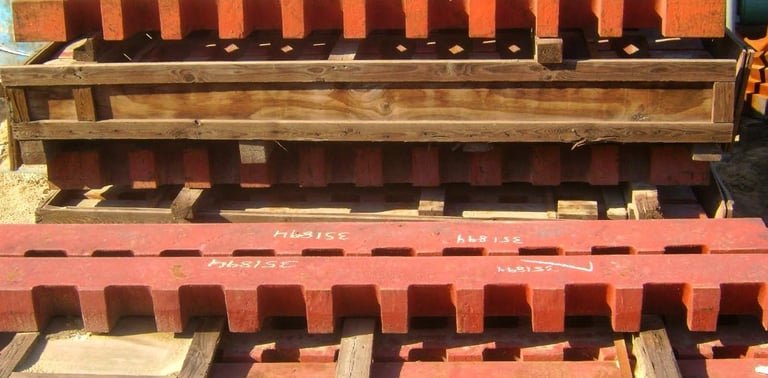
| Grates | Control discharge size and hold material in the chamber | Bar wear and hole enlargement | Mn13Cr2 / Mn18 |
| Anvils | Provide the surface material is crushed against | Impact wear and cracking | Mn18Cr2 |
| Pin protectors | Shield the rotor pins from direct impact | Wear through, then pin damage | Mn13Cr2 |
| Reject doors | Release unshreddables out of the chamber | Impact damage and distortion | Mn13Cr2 / alloy |
| Liners | Protect the housing from the material stream | Abrasion and impact wear | Mn13Cr2 / alloy |
Grades shown are designations commonly specified for each duty. The grade for your order is confirmed against your feed and how the last set failed.
Breaker bars, end disc caps, front walls and other housing components can normally also be produced from a drawing or a worn sample where a machine needs them.
Hammers wear fastest, so they are usually replaced alone. That is often a false economy, because the parts around them decide how the new hammers wear.
Worn grates let oversize material stay in the chamber longer, which raises the work each hammer does. Worn pin protectors expose the pins, and pin wear then shows up as eye elongation on hammers that would otherwise still be serviceable. Worn liners change how material moves through the chamber and shift the wear pattern across the rotor.
The practical consequence: a new set of hammers fitted into worn surroundings will not reach the life the same hammers achieved last time, and the foundry usually gets blamed for it. Where a shutdown is planned, quoting the surrounding parts at the same time is almost always the cheaper decision.
High manganese steel is the standard answer for shredder duty because it work hardens at the struck surface under impact while the core stays tough and ductile. The common designations are:
Hardness and toughness always trade against each other. If parts are breaking, the answer is more manganese, not less; if they are wearing round while staying intact, there is room to go harder. Our guide to reading hammer wear before you reorder covers how to tell which.
Our shredder wear parts are widely used in:
These applications require wear parts capable of handling continuous impact and heavy loads.
The more of this we have, the faster and more accurate the quotation:
Photographs of worn parts are worth more than they sound. A worn part records what actually happened inside your machine, which a specification sheet cannot.
We supply recycling operators and shredder plants directly, and also distributors, importers and traders reselling into their own markets. Supply information is on our distributors page.
Evaluating an Indian foundry for the first time? Our buyer's guide to sourcing wear parts from India covers what to ask any supplier and how to run a trial order that gives a usable answer.
We also manufacture shredder hammers, ELV shredder hammers, dual hardness shredder hammers and a complete range of HSI impactor blow bars for crushing and recycling applications.
Hammers are covered by machine on our Lindemann, TexasShredder and Newell and Wendt, Shred-Tech and Metso pages.
Related reading: why shredder hammers fail early, and what the worn parts tell you about the grade to order next.
Shredder hammers, grates, anvils, reject doors, liners and pin protectors, produced mainly in high-grade manganese steel for scrap and ELV shredding lines. Parts not listed can usually still be made from a drawing or sample.
Austenitic manganese steel work hardens in service - the struck surface hardens under repeated impact while the core stays tough. That combination is what stops parts shattering under the shock loads a shredder produces.
Usually yes, if a shutdown is already planned. Worn grates keep oversize material in the chamber longer and worn pin protectors expose the pins, so both shorten the life of the new hammers. Replacing hammers alone is often a false economy.
That is usually a pin and pin protector problem rather than a hammer grade problem. Check pin condition, pin material and rotor tolerance first, because a metallurgy change will not correct bearing stress at the pin.
Yes. A worn sample or photographs with key dimensions are normally enough to develop a pattern. Pattern cost, if any, is confirmed with the quotation before production.
Yes. Most plants order a mix, and ordering the set from one foundry keeps the metallurgy and the wear behaviour consistent across the machine.
Hardness test reports and material certificates are issued per production batch, so consistency can be verified across repeat orders.
Most new supply relationships begin with a trial quantity so fitment and wear performance can be verified in service before committing to volume.
Send your machine model, a drawing or photographs of a worn part. Our team confirms fitment and recommends the grade before quoting – usually within one working day.