
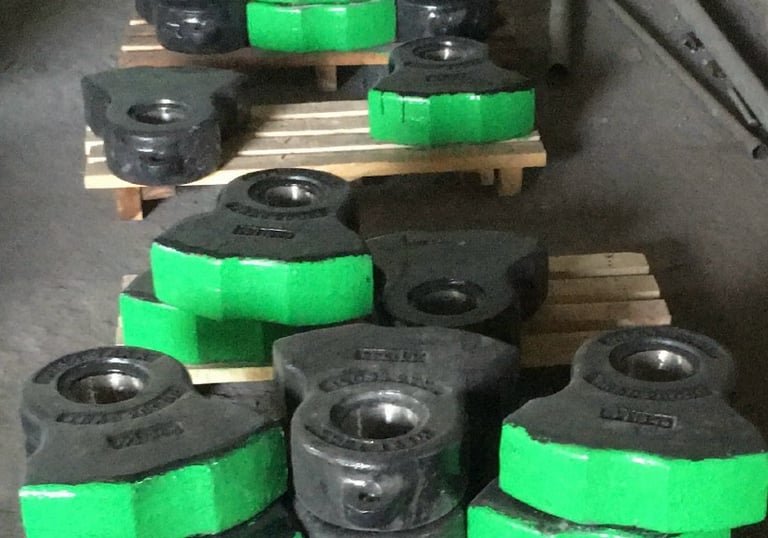
The Hammer That Came Out of Your Rotor Is a Diagnostic Report
Two recycling plants run the same shredder, on similar feed, with hammers bought from the same supplier. One changes hammers every eight weeks. The other runs eleven. The difference is almost never the price paid per hammer — it is whether anyone looked at the worn hammers before ordering the next set.
A shredder hammer that comes out of service carries the full record of what killed it. Most plants scrap that record without reading it, reorder the same specification, and get the same result. This guide is about reading it.
Three Ways a Shredder Hammer Dies
Almost every hammer failure falls into one of three categories. They look completely different, they have different causes, and — this is the part that costs money — the fix for one makes the others worse.
The hammer breaks. Usually a clean or coarse fracture through the body or across the eye, caused by a shock load the material could not absorb — an engine block, a compressed bale, an unshreddable. The grade was too hard or too brittle for the energy involved.
The striking face rounds off and the hammer loses weight while staying structurally sound. Caused by abrasion rather than shock: dirt, sand, glass, fine debris. The grade was tough enough but not hard enough at the working surface.
The pin hole stretches from round to oval until the hammer must come out, often while the striking face still has usable life. Caused by bearing stress at the pin, sometimes worsened by pin wear or a rotor running out of tolerance.
Why the Fix for One Makes the Others Worse
Hardness and toughness pull against each other. Increase hardness and the face holds its profile longer, but the hammer becomes more likely to crack under shock. Increase toughness and it survives the engine block, but the face wears round faster and the hammer sheds weight.
So a plant that responds to fractures by ordering something tougher will often start seeing face wear instead. A plant that responds to face wear by ordering something harder starts breaking hammers. Both plants conclude their supplier is inconsistent. Neither has changed supplier — they have moved along the same trade-off curve without knowing it.
The question is not “which hammer is best”. It is “which failure am I willing to accept”.
Every grade choice accepts one failure mode in order to push back another. The plants with the best cost per tonne are simply the ones that chose deliberately, based on what their own worn hammers showed them.
Matching the Grade to the Failure
Once you know which of the three is ending your hammers, the direction to move becomes clear:
- Hammers fracturing
- Move toward high manganese steel. Its austenitic structure work hardens at the struck surface under impact while the core stays tough and ductile, which is difficult to beat where shock loads dominate.
- Face wearing round
- Move toward higher surface hardness — an alloy steel, or a dual hardness construction that presents a hard face on a tougher body so you gain abrasion resistance without giving up impact strength at the eye.
- Eye elongating first
- This is often not a grade problem. Check pin condition, pin material and rotor tolerance before changing hammer specification, or you will pay for a metallurgy change that fixes nothing.
- Mixed or inconsistent
- Feed composition is likely swinging more than the specification can absorb. Worth reviewing feed control before changing grade, and worth discussing a compromise grade rather than optimising for one extreme.
The Cost Nobody Puts in the Spreadsheet
When plants compare hammer suppliers, they usually compare price per hammer. That number is the smallest part of what a hammer actually costs you.
Throughput decays before the hammer is finished
A shredder rotor delivers crushing energy in proportion to hammer mass and tip speed. As hammers wear, mass falls, and the energy delivered on every strike falls with it. Long before a hammer is formally worn out, output rate drifts down and product sizing drifts up. Very few plants log that decay, so it never appears as a cost — it just quietly reduces the tonnage the plant produces in a shift.
A change-out costs more than the parts
Every hammer change is production hours lost plus labour. A hammer set lasting meaningfully longer removes whole change-outs from the year. Two fewer shutdowns can outweigh a higher unit price several times over, and it never shows up if you are comparing quotations line by line.
One fracture can cost more than a year of hammers
A hammer that breaks in service does not only remove itself. It can damage grates, liners and in the worst cases the rotor. This is why chasing marginal abrasion resistance in a high-impact application is a poor trade — the downside is not a shorter hammer life, it is a rotor rebuild.
Work in cost per tonne processed, not cost per hammer.
It is the only number that includes wear life, downtime and throughput decay together — and it routinely reverses the conclusion you would reach from unit price alone.
What to Record Before You Reorder
You do not need a laboratory. You need four things written down at every change-out, and after two or three cycles the pattern becomes obvious:
- Tonnes processed since the last change — not weeks, because calendar time hides how hard the plant actually ran
- Which of the three failure modes ended the set, and roughly what proportion showed each
- The feed running during that period, and anything unusual that went through
- Photographs of two or three representative worn hammers, including the eye
That last point is worth more than it sounds. A photograph of a worn hammer tells a foundry more about your operation than a specification sheet does, because it shows what actually happened rather than what was intended.
Where the Right Supplier Changes the Answer
A supplier who quotes immediately, without asking what you are shredding or how the last set failed, is selling from stock rather than solving your problem. There is nothing wrong with buying from stock — but it will not change your cost per tonne.
What changes it is a foundry able to run several grades, willing to say when its own default grade is the wrong choice for your line, and able to cast to your dimensions when a standard hammer is not the answer. That conversation starts with your worn hammers, not with a price list.
Send us photographs of your last set of worn hammers, the tonnes they ran and what you are shredding. Our team will tell you which failure mode is limiting you and which grade moves it — whether or not the answer is a hammer from us.
Related Reading
For grade-level detail, see manganese steel vs alloy steel shredder hammers and shredder hammer materials, design and wear life. For the products themselves, see our shredder hammers, ELV shredder hammers and dual hardness shredder hammers.