
Wear-resistant castings for crushing and grinding plants, manufactured in high chrome, manganese and martensitic grades as OEM-compatible replacements or to your own drawings and samples.
Visit Our Main Company Website: www.melcocastings.com
Crusher wear parts are consumables by design: they are meant to be sacrificed so the machine is not. What separates a good supply relationship from a poor one is not whether the parts wear, but whether they wear predictably enough to plan around and long enough to justify what they cost per tonne.
Melco Precisions Pvt Ltd manufactures these parts from its own foundry, with grades selected against the duty rather than taken from a single catalogue specification.
Wear parts are manufactured across the crushing and grinding circuit:
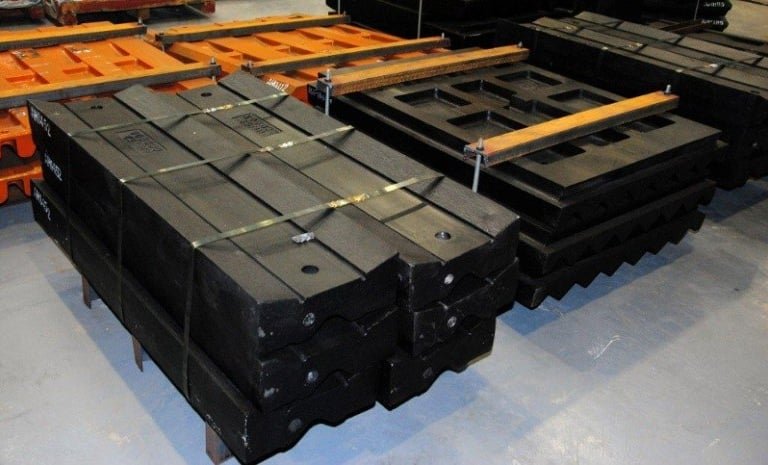
Blow bars are the most frequently replaced crusher wear part, and fitment is machine-specific. Model-level pages cover the machines most often asked about:
| Crusher Brand | Coverage | Page |
|---|---|---|
| Hazemag, SBM, Rubble Master, McCloskey | APK series, APS series, 1010 | View models |
| Stedman, Eagle, Metso | UM15, UM25 / 1200, UM45 / 1400 | View models |
| Kleemann | MOBIREX MR130 | View models |
| Powerscreen | Trackpactor 500 | View models |
| Sandvik | QI series range | View models |
| Keestrack | R series range | View models |
| Terex Finlay | I and IC series range | View models |
| Tesab, Hartl, Lippmann | full range, to drawing or sample | View models |
Brand and model names identify machine fitment only and imply no affiliation with any manufacturer.
If your machine is not listed, it can normally still be produced from a drawing or a worn part.
Three grades cover most crusher duty, and the choice between them is decided by whether abrasion or impact is ending your parts – not by which is nominally better.
The abrasion answer. Holds a working edge in hard, siliceous rock such as limestone, granite and river gravel. Less forgiving of heavy shock and tramp metal.
The impact answer. Work hardens at the struck surface while the core stays tough, which suits recycling, demolition feed and any circuit where tramp metal is routine. Wears faster in genuinely abrasive rock.
The middle ground, chosen deliberately where feed swings between the two and neither extreme grade performs consistently through the month.
Exact chemistry and hardness are confirmed against your application with the quotation, and can be certified per batch on request.
Quotations are compared on unit price because that is the number printed on them. It is also the number least connected to what a wear part actually costs.
Three things sit outside it. Throughput and product gradation drift as the working surface wears back, often well before anyone would call the part finished. Every change-out is production time plus labour, so a part lasting meaningfully longer removes whole shutdowns from the year. And a part that fractures in service can damage the rotor, liners and whatever sits downstream – a cost that dwarfs the saving on the original order.
Working in cost per tonne processed captures all three, and it routinely reverses the conclusion that unit price alone would give.
Photographs of worn parts are worth more than they sound – a worn part records what actually happened in your machine, which a specification sheet cannot.
We supply quarries, cement plants and recycling operators directly, and also distributors, importers and traders reselling into their own markets. Supply information is on our distributors page.
Evaluating an Indian foundry for the first time? Our buyer's guide to sourcing wear parts from India sets out what to ask any supplier and how to run a trial order that gives a usable answer.
Blow bars for horizontal shaft impactors, VSI impellers and anvils, ball mill liners, apron feeder parts and shredder wear parts, along with custom castings produced to drawing or sample.
No. They are OEM-compatible replacements manufactured by Melco Precisions Pvt Ltd. Brand and model names are used only to identify the machines the parts are made to fit and imply no affiliation with those manufacturers.
Usually yes. A worn part is normally enough to develop the pattern, which is how most components for older machines get made. Pattern cost, where any applies, is confirmed with the quotation before production starts.
By how your current parts are failing. Edges wearing round while the part stays sound points to abrasion, so a harder grade helps. Cracking or broken corners point to impact, so a tougher grade is needed. Send photographs of the worn parts and our team will advise.
Yes. We export crusher wear parts to the USA, Australia, UAE, UK, Germany, Spain, Russia and several African markets, supplying both end users and distributors.
Most new supply relationships begin with a trial quantity so fitment and wear performance can be verified before committing to volume.
Send your machine model, a drawing or photographs of a worn part. Our team confirms fitment and recommends the grade before quoting – usually within one working day.