
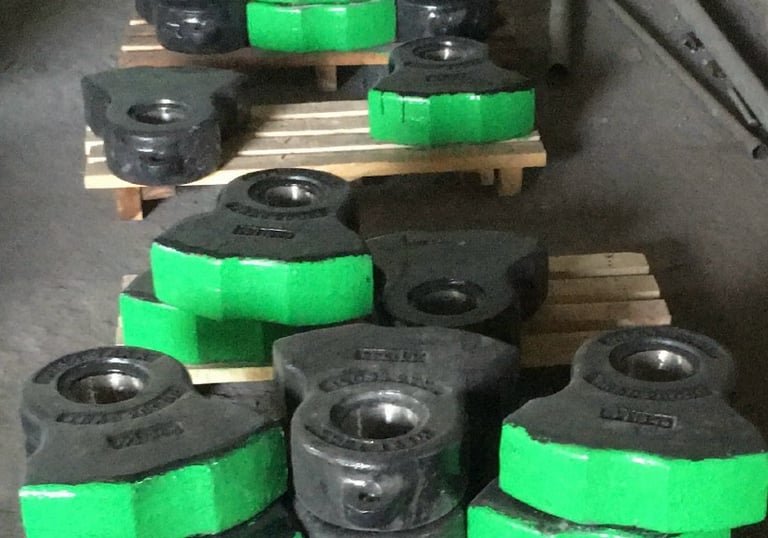
Shredder hammers built so the striking face resists abrasion while the body and eye keep the toughness needed to survive impact. Manufactured for scrap, ELV and industrial shredding lines, and supplied to export markets.
Visit Our Main Company Website: www.melcocastings.com
Every shredder hammer is a compromise between two properties that pull in opposite directions. Hardness resists abrasion and keeps the striking face from rounding off. Toughness resists cracking when the hammer meets an engine block or a compressed bale. Increase one in a single uniform casting and you generally reduce the other.
A uniformly hard hammer holds its profile but is more likely to fracture. A uniformly tough hammer survives impact but loses weight and geometry at the face, and as hammer weight falls the rotor delivers less crushing energy, so throughput and product size both suffer.
Dual hardness construction breaks that compromise by not treating the hammer as one material problem. The face and the body are asked to do different jobs, so they are given different properties.
The striking face is produced at a substantially higher hardness than the body. The body and the eye area retain a tougher, more ductile structure that can absorb shock loads and resist crack propagation.
The result is a hammer that keeps a sharper working profile for longer without becoming brittle where brittleness would be dangerous. In practice, plants adopt dual hardness when they can see the hammer is being replaced because of face wear rather than because of cracking or eye elongation.
Dual hardness is not automatically better than high manganese steel. It is better for a specific set of conditions. It is usually worth evaluating when:
Where hammers are fracturing, or where the feed is dominated by very heavy shock loads, standard high manganese steel is often still the correct answer. Its work-hardening behaviour is difficult to beat under pure impact.
Manganese steel arrives relatively soft and work hardens in service, which makes it outstanding under impact but slower to resist abrasion in the early hours of a hammer's life. A dual hardness hammer presents a hard face from the first strike, which matters where the abrasive component of wear is dominant.
A uniformly hardened alloy hammer resists abrasion well but carries a higher fracture risk in shock-loaded shredding. Dual hardness keeps that abrasion resistance at the face while leaving the body able to deform rather than crack.
Dual hardness hammers are cast to OEM replacement dimensions or to a customer-supplied drawing, sample or pattern. Hammer weight, eye diameter and face geometry are matched to the rotor they will run on.
Melco Precisions Pvt Ltd casts from approximately 1 kg to 2000 kg per piece across two integrated foundry facilities, with hardness testing and material certificates supplied per production batch.
Melco Precisions Pvt Ltd supplies shredder wear parts internationally to recycling operators, OEMs, distributors and traders, with shipments to the USA, Australia, UAE, UK, Germany, Spain, Russia, South Africa, Zambia, Congo, Ghana, Morocco, Algeria, Tunisia and Yemen.
For order quantities, lead times and supply terms, see our information for distributors and importers.
See also our ELV shredder hammers, the wider shredder hammer range, and shredder wear parts including grates, anvils and pin protectors.
For machine-specific fitment, see hammers for Lindemann, TexasShredder and Newell and for Wendt, Shred-Tech and Metso shredders.
For a fuller technical comparison of hammer metallurgy, read manganese steel vs alloy steel shredder hammers.
Not sure whether dual hardness is the right answer for your line? Our guide to why shredder hammers fail early shows how to tell face wear from fracture.
The striking face is produced at a substantially higher hardness than the body of the hammer. The face resists abrasion and holds its working profile, while the body and eye area keep the toughness needed to absorb shock loads without cracking.
No. Where hammers are fracturing or the feed delivers very heavy shock loads, high manganese steel is often still the better choice because its work-hardening behaviour is difficult to beat under pure impact. Dual hardness pays off when hammers are being replaced due to face wear rather than breakage.
Look at why hammers come out of service. If the striking face is worn round and the eye still has life, abrasion is your limiting factor and dual hardness is worth evaluating. If hammers are cracking or the eye is elongating first, the change will not help.
Yes. They are cast to OEM replacement dimensions or to your own drawing, sample or pattern, with hammer weight, eye diameter and face geometry matched to your rotor.
Yes. Hardness test reports and material certificates are supplied per production batch, which matters particularly on dual hardness parts where two hardness zones must be verified.
Send your machine model, a drawing or photographs of a worn part. Our team confirms fitment and recommends the grade before quoting – usually within one working day.