
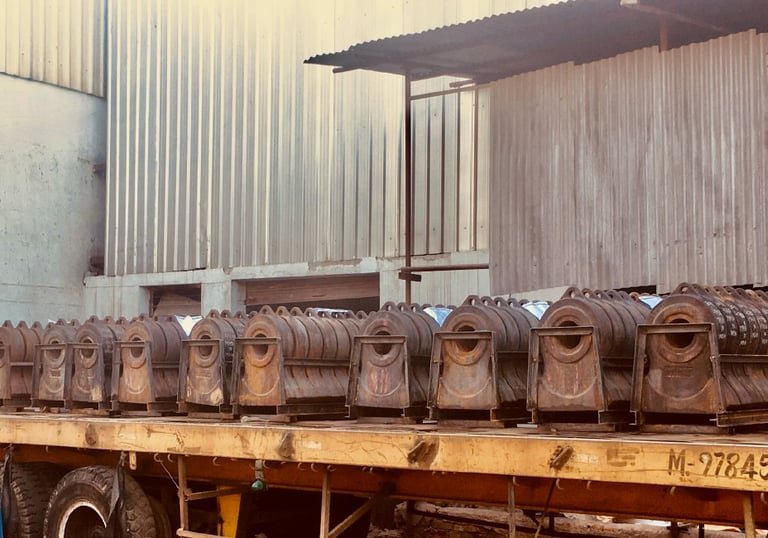
Choosing between manganese steel and alloy steel shredder hammers is one of the most important decisions a recycling or scrap processing plant makes - and one of the most misunderstood. Both materials are widely used across the industry, but they behave very differently under real operating conditions. This guide breaks down the metallurgy, performance, and cost factors so you can make the right call for your shredder.
Manganese steel and alloy steel shredder hammers each perform differently depending on your shredding application. Compare metallurgy, wear resistance, toughness, cost, and lifespan to choose the right hammer for your plant.
Why Hammer Material Matters More Than You Think
Shredder hammers are consumable wear parts, but the material you choose directly affects:
How often you need to stop production for replacement How consistent your output particle size stays over a hammer's life Your total cost per ton of material processed (not just cost per hammer) How well the hammer holds up against the specific mix of metals passing through your shredder
A hammer that looks cheaper upfront can end up costing more if it wears out in half the time or causes uneven shredding that affects downstream separation.
Manganese Steel Hammers - How They Work
Manganese steel used in shredder hammers is typically Hadfield's manganese steel, containing around 12-14% manganese along with controlled carbon content. Its defining property is work-hardening: when the hammer surface is struck repeatedly under high-impact loads, the crystal structure at the point of impact hardens progressively, while the internal core remains tough and ductile.
This gives manganese steel hammers a unique advantage - they get harder exactly where they need to, right at the wear surface, without becoming brittle throughout. That's why they're the standard choice for:
Auto body and end-of-life vehicle (ELV) shredding Mixed metal scrap streams with unpredictable density and shape Heavy-impact shredding where shock resistance matters as much as hardness Operations where hammers experience sudden, uneven impact loads
Typical hardness range (as-cast): 200-230 BHN, work-hardening to 500+ BHN at the impact surface with use.
Alloy Steel Hammers - How They Work
Alloy steel hammers are generally through-hardened or heat-treated to achieve high hardness before they ever go into service. Unlike manganese steel, they don't rely on work-hardening - the hardness is built in from the start through the alloy composition and heat treatment process (often involving chromium, nickel, or molybdenum additions).
This makes alloy steel hammers well-suited for:
Abrasive wear-dominant applications (as opposed to pure impact) More uniform, predictable feed material Applications where consistent hardness from day one matters more than long-term work-hardening
Typical hardness range: 450-550 BHN from the start, but this can decline as the surface wears, since there's no work-hardening mechanism to renew it.
Side-by-Side Comparison
Factor Manganese Steel Alloy SteelInitial hardnessLower (200-230 BHN)Higher (450-550 BHN)Hardening mechanismWork-hardens under impactFixed via heat treatmentBest forMixed, unpredictable impact loadsUniform, abrasion-dominant wearToughness (crack resistance)ExcellentModeratePerformance over timeImproves at wear surface with use Gradually declines as hardened layer wears Typical use case Auto/ELV shredding, scrap metal Abrasive material processing
Cost vs Longevity - The Real Comparison
It's tempting to compare hammers purely on upfront price, but that misses the bigger picture. What actually matters is cost per ton of material processed over the hammer's working life.
Manganese steel hammers often have a slightly lower upfront cost, and because they work-harden in use, they tend to maintain effective wear resistance for longer in genuinely high-impact applications. Alloy steel hammers start harder, but once that outer hardened layer wears through, the remaining material doesn't have the same self-reinforcing property - so performance can drop off more sharply toward the end of the hammer's life.
For plants importing hammers from overseas - especially in the USA, Australia, and UAE - this matters even more, because every replacement order involves shipping lead time, customs clearance, and potential production gaps while waiting for parts. Choosing a hammer that lasts predictably longer reduces how often you're exposed to that logistics cycle.
How to Decide Which One Is Right for Your Plant
Ask these questions before choosing:
- What are you shredding? Mixed automotive scrap and ELVs → manganese steel. Uniform, abrasive material → alloy steel may perform better.
- How variable is your feed material? Unpredictable density and shape favor manganese steel's toughness.
- What's your maintenance schedule like? If unplanned downtime is costly, manganese steel's gradual, predictable wear pattern is usually easier to plan around.
- What's your shredder's impact intensity? Higher-impact rotors generally favor manganese steel's shock resistance.
A Note on Quality Consistency
Regardless of which material you choose, the bigger risk for import buyers isn't manganese vs. alloy - it's batch-to-batch inconsistency from a supplier. A hammer that tests well in one shipment but varies in hardness or composition in the next creates unpredictable wear life and complicates maintenance planning. Always ask your supplier for material test certificates and hardness reports on every batch, not just the sample.
FAQs
Q: Can I switch from alloy steel to manganese steel hammers without changing my shredder setup?
In most cases, yes — as long as the hammer dimensions and mounting match your rotor specifications. We recommend confirming rotor speed and impact profile with your supplier before switching.
Q: Do manganese steel hammers need a "break-in" period?
Yes, to some extent. Work-hardening develops with use, so wear resistance improves over the first period of operation as the impact surface hardens.
Q: Which material is better for high-volume, continuous shredding operations?
Manganese steel is generally preferred for continuous, high-impact operations because its toughness reduces the risk of cracking under sustained heavy use.
Q: How do I verify hammer quality before a large export order?
Request material certificates, hardness test reports, and if possible, a sample batch for trial before committing to a full container order.
Our Recommendation
For most scrap and metal recycling operations we supply to across the USA, Australia, and the UAE, manganese steel remains the more reliable long-term choice - its ability to handle mixed, unpredictable feed material without cracking makes it the safer default for most shredder setups. That said, we manufacture both manganese steel and alloy steel hammers, and the right choice ultimately depends on your specific shredder model, rotor design, and feed material.
Share your shredder model and typical feed material with us, and we'll recommend the right hammer specification - along with material certificates - for your operation.
Looking for High-Quality Shredder Hammers?
Contact us today to get a quick quotation.