
You Are Buying Castings From 6,000 km Away. Now What?
Very few buyers of wear parts get to walk a foundry floor before placing an order. Flights are expensive, schedules do not align, and the supplier being evaluated may be one of four on a shortlist. So the assessment happens remotely, usually on the basis of a website and a price list — which is to say, barely at all.
It can be done far better than that without leaving your desk. This is a structured way to do it.
Start With What the Questions Reveal
Before requesting documents, notice something simpler: what does the supplier ask you?
A works that quotes immediately from a part number, without asking what you are crushing, how the last set failed or what the part weighs, is selling from a catalogue. There is nothing dishonest about that. But it cannot improve your cost per tonne, because the grade was decided before your application entered the conversation.
A supplier who asks about feed material, tonnage achieved and failure mode is doing engineering. That difference tells you more than any certificate, and it costs nothing to observe.
The first question to ask is what they ask you.
A quotation that arrives without a single question about your application is a price, not a recommendation.
The Process Questions That Matter
You do not need to audit a heat treatment shop personally. You need to know whether the supplier controls the steps that decide performance:
- Is melting done in house?
- Some traders present themselves as manufacturers. Ask directly whether the parts are poured at their own works, and if not, who pours them and how the process is controlled.
- Is heat treatment in house or subcontracted?
- For manganese steel this is the single largest determinant of performance. If subcontracted, ask who verifies the cycle and whether records are supplied.
- How is soak time set for heavy sections?
- A works that applies one standard cycle to every part regardless of thickness is not controlling the process on large castings.
- Where are hardness tests taken?
- From the part itself, or from a separately cast test bar? A test bar quenched alone tells you about the test bar, not the centre of a heavy hammer.
- Is weld repair re-treated?
- Welding into a finished manganese casting re-creates the brittleness heat treatment removed. If repairs are not re-solution treated, the weld becomes the crack site.
You are not looking for perfect answers. You are looking for whether the person answering understands the question — and whether they say “we subcontract that” plainly rather than avoiding it.
The Video Call, Used Properly
A video walkthrough is the closest thing to a visit, and most buyers waste it by treating it as a sales presentation. Ask for specific things, live:
- The melting area during a pour, or immediately after
- The heat treatment furnaces, with the controller display readable
- The quench tank, and how far parts travel from furnace to quench
- The pattern store, which indicates how much bespoke work they genuinely do
- Parts of your type in production or in the finished goods area
- The testing area, and the equipment actually used for hardness checks
Ask for these on the call rather than in advance. Pre-recorded footage is easy to curate; a live walk to a specific area is not. A works with nothing to hide will simply carry the phone there.
Documents Worth Requesting
Ask for real examples, not blank templates:
- A material test certificate from a recent batch of a similar part
- A heat treatment record, if the process is in house
- Any third party inspection reports from recent shipments
- A packing photograph from a previous export shipment
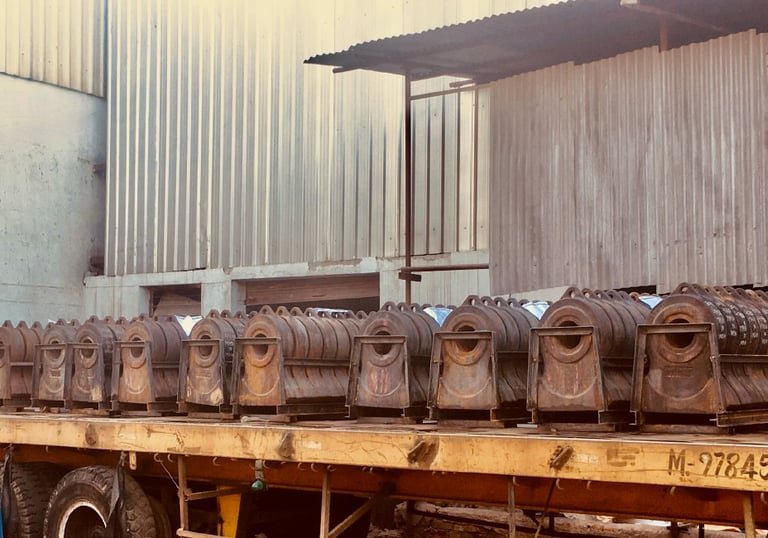
That last one is more useful than it sounds. Photographs of how heavy castings were actually strapped and loaded tell you whether the works has genuine export experience or is learning on your order.
Third Party Inspection
For a first order of meaningful value, an independent pre-shipment inspection is inexpensive relative to the exposure. An inspector can verify quantity, dimensions, markings and packing before the container is sealed, and can witness testing where that has been agreed.
A supplier confident in the order will accept this readily. Resistance to independent inspection on a first shipment is worth paying attention to — not as proof of a problem, but as a question that deserves an answer.
Structure the First Order to Limit Exposure
The best protection is not a document, it is order design:
A handful of parts tells you nothing about wear life. A full set for one machine is usually the right balance.
Drawing or sample approval, then a first-article check before the full run. Both cost days and prevent a container of wrong parts.
Tonnes rather than weeks. Photographs of parts coming out. Certificates retained so a later batch can be compared against them.
What a Trial Actually Proves
Run properly, a single trial answers two separate questions. Whether the parts perform — visible in tonnes achieved and the failure mode. And whether the supplier is workable — visible in how they handled the drawing stage, whether they raised problems early, and whether the documents arrived before the vessel.
The second question matters more over a multi-year relationship, and it is the one a price list cannot answer.
Warning Signs
- A quotation with no questions asked about the application
- Reluctance to show heat treatment or to say who performs it
- Certificates that are identical across different batches
- An offer to shorten heat treatment to meet a delivery date
- Resistance to third party inspection on a first order
- Claims of compatibility with every brand and model without qualification
We are happy to be assessed this way. Ask for a live walkthrough of melting, heat treatment and testing, request certificates from a recent comparable batch, and structure a first order with approval points. If anything above cannot be shown, we will tell you why rather than talk around it.
Related Reading
For the metallurgy behind the questions, see heat treatment of manganese steel castings. For the wider supplier evaluation, see our buyer's guide to sourcing from India and India versus China. For shipping, see incoterms and documentation.