
The Quotation Was the Easy Part
Buyers evaluating a new wear parts supplier spend most of their attention on price and metallurgy. The problems that actually delay a first shipment are almost never either of those. They are an incoterm nobody pinned down, a document that arrived late, or castings packed for a truck rather than a container.
This is a practical guide for distributors and importers buying crusher and shredder wear parts internationally — what to agree before the order, and what to expect at each stage.
Agree the Incoterm Before Comparing Prices
Two quotations are not comparable until you know what each one includes. This is the single most common source of a price difference that turns out not to be a price difference at all.
- EXW (Ex Works)
- The lowest headline number and the most work for you. Goods are made available at the works; you arrange collection, export clearance and everything after. Rarely the right choice for a first order with a new supplier in another country.
- FOB (Free On Board)
- The supplier delivers the goods loaded on the vessel at the named port of shipment and handles export clearance. You control the ocean freight and everything from there. Common where the buyer has a freight forwarder they trust and their own rates.
- CIF (Cost, Insurance and Freight)
- The supplier arranges and pays carriage and insurance to your named destination port. Simpler for the buyer, and a higher headline figure that includes freight. Useful for a first order while a relationship is being established.
- DAP / DDP
- Delivery to a named place, with DDP also covering import duties. Convenient but the supplier prices in the uncertainty, and duty handling by a foreign party is often less efficient than doing it yourself.
A practical approach: ask for the same order quoted both FOB and CIF. The gap tells you what the supplier is paying for freight, which is useful information whichever you eventually choose.
An FOB quotation is not cheaper than a CIF quotation.
It is a different quotation. Comparing one supplier’s FOB against another’s CIF is the most common way importers reach a wrong conclusion about price.
The Documents a Shipment Needs
Requirements vary by destination, so treat this as the common core rather than a complete list for your country:
- Commercial invoice — values, terms and the incoterm stated explicitly
- Packing list — contents, gross and net weights, and dimensions per package
- Bill of lading — issued by the carrier; the document your goods are released against
- Certificate of origin — often needed for customs, and essential where a preferential trade agreement applies
- Material test certificates — chemistry and hardness per production batch
- Insurance certificate — where the term includes insurance
Agree at order stage who prepares each of these and how they will be transmitted. Documents arriving after the vessel is a routine cause of demurrage charges, and those charges are rarely recoverable from anyone.
Classification and Duty
Wear parts are castings, and how they are classified affects the duty you pay. Confirm the tariff classification your customs authority expects for the specific part before the first shipment rather than after it — reclassification arguments at the border are slow and expensive.
Where a preferential trade agreement exists between the supplying and importing countries, a valid certificate of origin can reduce or remove duty. This is worth checking early, because the saving is often larger than the price difference you were negotiating over.
Your customs broker is the right authority on both points for your country. A supplier can tell you what they normally declare; they cannot tell you how your customs will treat it.
Packing Heavy Castings Properly
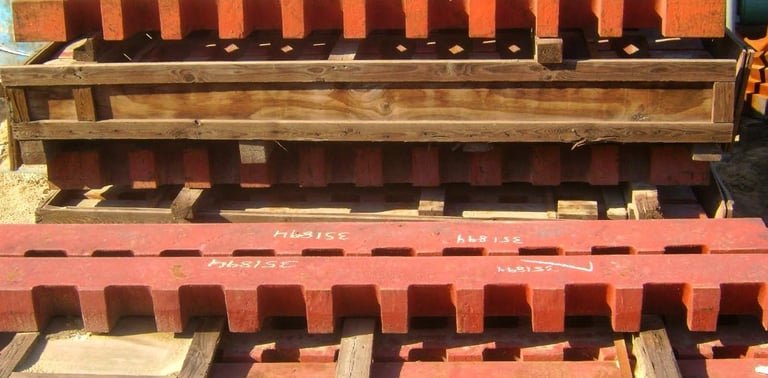
Wear parts are dense, awkward and unforgiving of poor packing. A pallet of blow bars that shifts in transit damages the container, the goods and sometimes the person opening the doors.
What to specify:
- Steel strapping or welded steel frames rather than plastic wrap alone for heavy items
- Weight per package kept within what your receiving equipment can lift
- Load distributed across the container floor, not concentrated at one end
- ISPM 15 treated timber where wooden packaging is used, which most countries require
- Part numbers marked on the packages, not only on the paperwork
That last point saves real time. A container of similar-looking castings with identification only on an invoice turns receiving into a measuring exercise.
Planning Lead Time Realistically
A wear part order has more stages than a stocked component, and each one is a place a schedule slips:
Where a new pattern is needed, this stage exists and takes time. Sending a worn part promptly is the single biggest thing a buyer controls.
Heat treatment in particular cannot be compressed without damaging the properties you are paying for. Treat a supplier who offers to rush it as a warning.
Ocean transit is the visible part, but booking availability and port congestion move dates more often than sailing time does.
The practical consequence for a distributor is that reorder points must be set from total lead time, not production time. Ordering when stock runs low works with a domestic supplier and fails with an imported one.
Payment Terms on a First Order
Neither side has history on a first order, so terms tend to be conservative — commonly an advance against order with the balance against shipping documents. As a relationship establishes and repeat orders build a record, terms usually open up.
A reasonable approach for a first order is to keep the quantity modest enough that the commercial exposure is acceptable, while keeping it large enough to be a genuine test of the parts. A trial of a handful of pieces proves very little about wear life.
Making a Trial Order Actually Prove Something
- Change the full set rather than a few positions, so the comparison is clean
- Run it on normal feed, not during an unusual contract
- Record tonnes processed rather than calendar weeks
- Photograph the parts when they come out, including the mounting faces
- Keep the batch certificates so a later order can be compared against them
Done this way, one cycle gives you a defensible answer. Done casually, it produces an opinion that gets argued about for a year.
Questions Worth Asking Before the First Order
- Can this be quoted both FOB and CIF to my port?
- Which documents will be provided, and how soon after shipment?
- Is a certificate of origin available, and in what form?
- How will the goods be packed, and what is the weight per package?
- What is the realistic total lead time, including pattern work if any?
- Are material certificates issued per production batch?
Tell us the parts you move, the machines your customers run, your destination port and the volumes involved. We will come back with grades, both FOB and CIF pricing, packing details and a realistic lead time — so the comparison you make against your current supplier is a fair one.
Related Reading
For evaluating the foundry itself, see our buyer's guide to sourcing wear parts from India and what to ask about heat treatment. For working out whether a change of supplier pays, see calculating cost per tonne. Supply information is on our distributors page.