
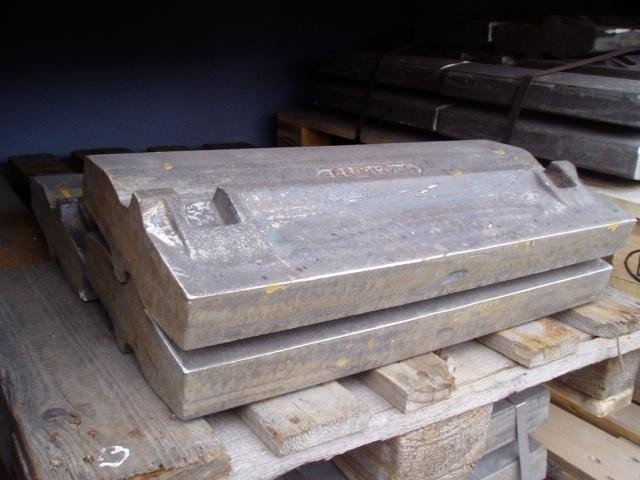
The Cheaper Bar That Costs More: Working Out Cost Per Tonne
Two quotations arrive. One is fifteen percent cheaper per part. Most purchasing decisions stop there, because unit price is the only number both quotations actually contain — and it is the number least connected to what the parts will cost you over a year.
This is a method for working out the real figure. It needs no software and no data you do not already have, and it routinely reverses the conclusion that unit price alone would give.
The Basic Calculation
Start with the number almost every plant can produce:
Cost per tonne = (set price) ÷ (tonnes processed by that set)
Note that it is the price of a complete set, not one part, and tonnes rather than weeks. Calendar time hides how hard the plant actually ran, and a set that lasted “three months” through a slow quarter is not comparable to one that lasted three months flat out.
Worked as an illustration, with figures chosen only to show the method:
- Supplier A
- Set price 1,000 currency units. Ran 40,000 tonnes. Cost per tonne = 0.025 units.
- Supplier B
- Set price 1,300 currency units. Ran 58,000 tonnes. Cost per tonne = 0.0224 units.
- Result
- Supplier B is 30% more expensive per set and roughly 10% cheaper per tonne. On unit price alone you would have chosen wrong.
That much is familiar to most plants. The three costs below are the ones that usually stay invisible, and they are frequently larger than the difference the calculation above reveals.
Hidden Cost One: Change-Out Downtime
Every change is production hours lost plus labour. Blow bar and hammer changes are heavy, awkward work, and the plant is not earning while they happen.
Add it in like this:
Change cost = (hours down × hourly production value) + labour
Then add that to the set price before dividing by tonnes. The effect is often decisive: a set lasting 45% longer does not simply cost less per tonne, it removes whole shutdowns from the year. Two fewer change-outs on a plant earning meaningful revenue per hour can be worth more than the entire price difference between the two quotations.
Longer wear life is worth more than the wear-life difference suggests.
Because it removes fixed change-out costs from the year, not just material cost per tonne.
Hidden Cost Two: Throughput and Gradation Decay
This is the cost almost nobody logs, and on a spec-driven site it can be the largest of the three.
A worn striking edge does not simply have less material left. It changes the crushing action. Product gradation drifts, and on a shredder the energy delivered per strike falls as hammer mass reduces. Output rate declines and product sizing moves before anyone would call the parts finished.
Two practical consequences. If you are selling to a specification, you may be reprocessing or downgrading product while the parts are still nominally serviceable. And if throughput drifts down over a set’s life, the tonnes-per-hour figure you plan around is an average that hides a declining curve.
You do not need to model this precisely. Simply noting output rate at the start and end of a set makes the decay visible, and a grade that holds its profile longer will show a flatter curve.
Hidden Cost Three: The Failure That Takes Something With It
A part that fractures in service rarely fails alone. A broken blow bar can damage the rotor, the impact aprons and whatever sits downstream. A shredder hammer that breaks can take grates and liners with it.
This cost does not average smoothly across tonnes — it arrives once and is large. It is also the reason chasing marginal abrasion resistance on shock-loaded duty is a poor trade: the downside is not a shorter wear life, it is an unplanned rebuild.
Treat it as a risk weighting rather than a line item. If a grade choice raises the chance of fracture, the cost per tonne advantage has to be large enough to justify carrying that risk.
The Fuller Formula
Putting it together:
True cost per tonne = (set price + change-out cost + production lost to decay) ÷ tonnes processed
The third term is the hardest to quantify and the one worth estimating even roughly, because leaving it at zero systematically favours whichever supplier is cheapest per part.
What to Record So the Numbers Exist
None of this works without a log, and the log needed is short. At every change-out, write down:
- Tonnes processed since the last change
- Hours the machine was down, and how many people worked on it
- Output rate at the start of the set and just before the change
- Which failure mode ended the set, and whether it was even across all positions
- Feed material, and anything unusual that entered the chamber
- Grade and supplier
After two or three cycles this becomes the most valuable document in the maintenance office. It turns every future quotation into a technical discussion rather than a price negotiation, and it makes a supplier’s claims testable.
Running a Trial That Produces an Answer
A trial order only tells you something if the comparison is fair. Three rules make it usable:
- Change the full set, not a few positions. Mixed sets wear unevenly and prove nothing about either supplier.
- Run it on comparable feed. A trial during an unusual contract is not a comparison.
- Record tonnes, not weeks, and photograph the parts when they come out.
A trial run this way answers the question in one cycle. Run casually, it produces an opinion that gets argued about for a year.
What This Means When Comparing Suppliers
A supplier who quotes immediately, without asking what you are processing or how the last set failed, is selling from stock. There is nothing wrong with that — but stock cannot change your cost per tonne, because the grade was decided before your application was discussed.
What moves the number is a foundry able to run several grades, willing to say when its own default is wrong for your line, and able to cast to your dimensions when a standard part is not the answer.
Send us your current cost per set, the tonnes it achieves and photographs of how it comes out. We will work the cost per tonne with you and say honestly whether a different grade would move it — including when the answer is that your present specification is already the right one.
Related Reading
For grade selection, see manganese grades from Mn13Cr2 to Mn24Cr2 and high chrome grades from Cr14 to Cr26. For evaluating a new supplier, see our buyer's guide to sourcing from India.