
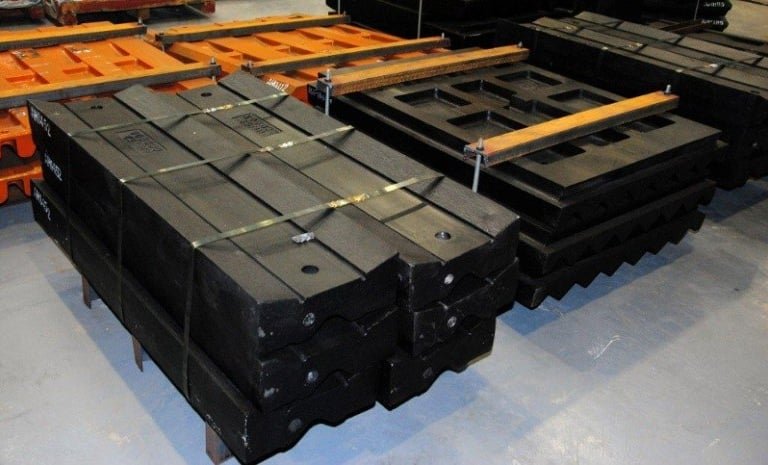
More Chrome Is Not Automatically a Better Blow Bar
Ask most buyers what separates a Cr26 blow bar from a Cr14 and the answer is usually “Cr26 is better”. It is harder and more abrasion resistant, so on a spreadsheet it looks like the upgrade. In a crusher chamber it is a trade, and plants that treat it as a straight upgrade are the ones reporting broken bars.
This guide covers what chromium actually does in a white iron, why the number should be matched to your feed rather than maximised, and what molybdenum changes.
What Chromium Does
High chrome blow bars are not steel. They are white cast irons, and their wear resistance comes from hard chromium carbides distributed through a metal matrix. Those carbides are far harder than the rock passing through the crusher, which is what lets the bar hold its striking edge.
Raising the chromium content increases the volume of carbide in the structure. More carbide means better resistance to abrasion — and less material between the carbides to absorb a shock. That single sentence explains almost every blow bar failure that gets blamed on quality.
Carbides resist wear. The matrix around them resists cracking.
Every step up in chrome trades some of the second for more of the first. The right grade is the one where that trade matches what actually enters your chamber.
Grade by Grade
- Cr14
- The toughest of the high chrome family, with the lowest carbide volume. It suits duty where abrasion matters but shock is a real risk — mixed feed, recycled material with occasional tramp, and machines whose feed cannot be tightly controlled. Where a plant has been breaking harder bars, this is often where the answer lies.
- Cr18
- A middle position and a common all-round choice. More abrasion resistance than Cr14 while retaining useful toughness. Frequently specified for aggregate work with reasonably consistent feed.
- Cr20
- Weighted toward abrasion resistance. Well suited to hard, abrasive quarried stone where feed is controlled and tramp metal is rare rather than routine. A common choice in limestone and granite production.
- Cr26
- The highest carbide volume and the best abrasion resistance in the range, with the least tolerance for shock. It performs excellently in clean, highly abrasive rock and disappoints badly anywhere unshreddables arrive. Also more resistant to corrosion, which matters in wet processing.
What Molybdenum Adds
These grades can be supplied with or without molybdenum, and the distinction is worth understanding rather than treating as an upsell.
Molybdenum improves hardenability — the ability to develop the desired matrix structure through the full thickness of the casting rather than only near the surface. On a thin bar it changes little. On a heavy section it can be the difference between a part that performs uniformly and one that is correct at the surface and softer in the middle.
So the question is not simply “is moly better” but “how thick is the part”. For large bars in heavy stationary impactors, a molybdenum-bearing version of the same chrome grade is often the sounder specification.
When a Manganese Steel Bar Beats Any Chrome Iron
It is worth stating plainly: on some duty no chrome grade is the right answer.
Where reinforced concrete, rebar and genuinely uncrushable objects are routine rather than occasional, an austenitic manganese steel such as Mn13Cr2 or Mn18Cr2 will outlast any chrome iron — not because it resists abrasion better, but because it does not crack. A bar that survives at reduced wear life beats a harder bar that breaks in week two and takes a rotor with it.
Plants running demolition and recycled concrete usually end up here. If your bars are breaking rather than wearing back, the chrome number is not the variable to adjust.
Choosing From Your Feed
As a practical starting point:
Cr20 or Cr26, with molybdenum on heavy sections. Feed control is what makes the higher grades safe here.
Cr14 or Cr18, or a CrNiMo steel. A deliberate compromise beats optimising for a duty the machine only sometimes runs.
Mn13Cr2 or Mn18Cr2. Toughness first; chrome irons crack on this work regardless of grade.
Hardness Figures Are Not the Whole Story
Two bars quoted at the same bulk hardness can wear very differently, because bulk hardness averages the hard carbides and the softer matrix into one number. What decides abrasion life is the carbide volume, their type and how they are distributed — and the heat treatment that sets the matrix around them.
That is why a hardness figure alone is a weak basis for comparing suppliers, and why batch certification covering both chemistry and hardness is more useful than either on its own.
Cost Per Tonne, Not Cost Per Bar
A Cr26 bar costs more than a Cr14 bar. On the right feed it can more than repay the difference through wear life and fewer change-outs. On the wrong feed it can cost several times its own price in one broken rotor.
The comparison worth making is cost per tonne crushed, which captures wear life, downtime and the gradation drift that occurs as the striking edge wears back. Unit price captures none of them.
What to Send for a Grade Recommendation
- Crusher make, model and whether it runs primary or secondary
- The material being crushed and typical feed size
- How often tramp metal enters the chamber, honestly assessed
- Tonnes achieved by the current bars and how the last set ended
- The weight of a single bar, which indicates section thickness
- The grade currently in use, if known
Send photographs of your worn bars with the tonnes they ran and what you are crushing. Our team will tell you which chrome grade the evidence supports, whether molybdenum is worth specifying at your section thickness, and whether a manganese steel would actually serve you better.
Related Reading
For diagnosing which failure mode you have, see blow bar wear patterns. For the manganese grades, see choosing between Mn13Cr2 and Mn24Cr2. Products: HSI impactor blow bars and crusher wear parts.