
Shredder Hammers: Materials, Design, Applications and Wear Life Guide
Shredder hammer materials, design, applications and wear life explained. Learn what controls service life and how to select the right grade and manufacturer.
A shredder hammer is the part of a shredding machine that actually does the work. Everything else, the rotor, the motor, the grates, the feed system, exists to put that hammer in contact with the material at the right speed and angle. When hammers are correctly specified, a shredder runs predictably and the maintenance schedule stays where it should be. When they are not, the effects show up across the plant: lower throughput, more frequent stoppages, rotor damage, and a maintenance team spending its week inside the shredder box instead of on planned work.
This guide covers the full picture: what these components do, how they are designed, which materials are used and why, what governs service life, and what to look for in a manufacturer. It is written for people who buy, specify or maintain shredder wear parts, and it assumes you want the reasoning behind a recommendation rather than a catalogue entry.
Two related topics are covered in detail elsewhere on this site. If you are weighing up specific alloys, the article on manganese steel and alloy steel shredder hammers compared goes deeper into that comparison than this piece does. If you are working through a purchase decision for a specific plant, the guide on selecting shredder hammers for a recycling plant covers that process step by step.
What Is a Shredder Hammer?
A shredder hammer is a heavy cast wear component mounted on the rotor of a hammermill-type shredder. Its job is to strike incoming material with enough force to tear, fracture or deform it into smaller pieces.
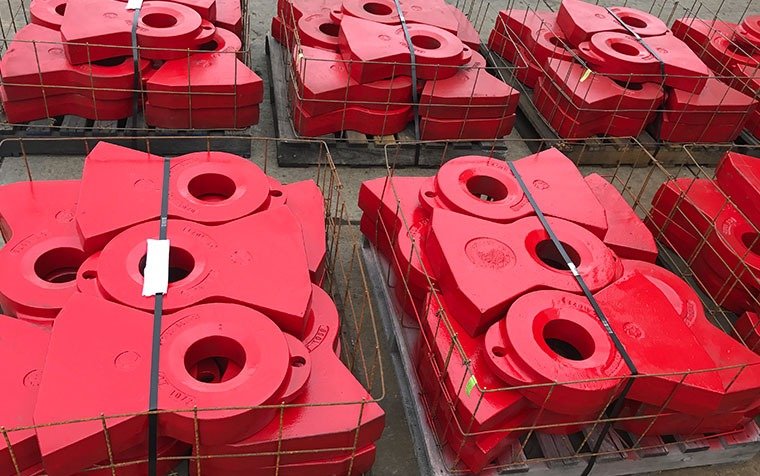
Physically, most hammers share a common form: a thick body with one or more mounting holes, and a working face or tip that takes the impact. The mounting hole receives a pin that passes through the rotor discs, allowing the hammer to swing freely. That swinging action matters. It lets the hammer move out of the way when it meets something it cannot break, which protects the rotor and the drive system from the full force of an uncrushable object.
Hammers vary considerably in size. A small industrial shredder handling light scrap may use hammers weighing a few dozen kilograms. A large automobile shredder processing car bodies uses hammers that require lifting equipment to handle, sometimes several hundred kilograms each. The casting principles are similar across that range, but the metallurgical demands and the manufacturing tolerances become more exacting as size increases.
It is worth distinguishing hammers from the other wear parts inside the same machine. Grates, liners, anvils, cutter bars and pin protectors all wear, and all need replacing on their own cycle. Hammers usually wear fastest because they take the direct impact, which is why they dominate the wear parts budget in most shredding operations.
How Shredder Hammers Work
The mechanism is straightforward in principle and demanding in practice.
Material enters the shredder box and falls or is fed into the path of a rotor spinning at high speed. Hammers mounted on that rotor strike the material. The energy transferred in each strike does the shredding, either by fracturing brittle material outright or by tearing and deforming ductile material such as sheet steel until it separates.
Fragments are thrown against liners, anvils and breaker plates inside the shredder housing, which causes further size reduction. Material continues circulating inside the chamber until it is small enough to pass through the grate openings at the bottom of the machine. Grate size therefore controls product size, and it also controls how long material stays inside being struck repeatedly.
Two consequences follow directly, and both affect hammer life.
Hammers do not strike material once. They strike it repeatedly as it circulates, so the face is in near-continuous contact with material moving at speed, and both impact loading and abrasive contact occur throughout the cycle. Fragments rebounding off liners also come back into the hammer path from unpredictable directions, so wear does not occur neatly on one face. Real hammers show wear on the leading edge, the tip, the sides and often around the mounting bore, and the distribution of that wear reveals a great deal about what is happening inside a machine you cannot see into while it runs.
The swing action is the second factor. Because hammers pivot on their pins, they align themselves under load rather than being held rigidly. This reduces shock transmission to the rotor, but it also makes the pin bore a working surface. Bore elongation is a failure mode in its own right and often determines when a hammer must come out even when the striking face still has material left.
Where Are Shredder Hammers Used?
The same basic component appears across several industries, but the operating conditions differ enough that hammers specified for one are frequently wrong for another.
Scrap Metal Recycling
General scrap processing is the largest single application. Shredders here handle a stream that changes hour by hour: light gauge sheet, structural offcuts, appliances, mixed ferrous and non-ferrous material, and whatever else arrives on the tip.
The defining characteristic is unpredictability. An operator can control feed rate and can exclude obvious problems, but cannot fully control what is inside a closed container or a compacted bale. Hammers in this application need toughness above all else, because the arrival of an unexpected solid object is not an exception, it is a routine event.
Automotive and ELV Recycling
End-of-life vehicle shredding is a demanding subset of scrap processing. Car bodies contain a mix of thin sheet steel, cast components, plastics, glass, rubber, residual fluids and occasionally items that were never meant to enter a shredder.
ELV shredders tend to be large, high-powered machines running continuously, and the hammers used in them are correspondingly heavy. Impact loading is severe, particularly where engine blocks, transmission housings or suspension components reach the rotor. Manganese steel dominates this application for reasons covered in the materials section below.
Throughput economics matter here more than in most applications. Because ELV plants run high volumes on tight margins, an unplanned stoppage is expensive, and hammer changeout scheduling is planned around production rather than fitted in when convenient.
Steel and Foundry Applications
Shredders used around steel plants and foundries handle returns, offcuts, runners, risers and process scrap. The feed is more consistent than general scrap, and it is usually cleaner, but it can be considerably denser and harder.
Cast iron returns, for example, are brittle and fracture readily, but they are also hard and abrasive. Hammers here face less unpredictable tramp risk but more sustained abrasive contact, which shifts the material selection toward harder grades than would be appropriate in an ELV plant.
Other Heavy-Duty Shredding Applications
Several other sectors use the same equipment type. Municipal and commercial waste shredding involves lower density feed but significant contamination risk, since waste streams routinely contain metal objects that were never sorted out. Wood and biomass processing uses hammermills of similar design, though the wear mechanism shifts toward abrasion from grit and soil rather than metal-on-metal impact. Construction and demolition waste shredding sits between scrap and aggregate processing, with concrete, rebar, timber and mixed material arriving together.
The common thread is that hammer selection follows the feed, not the machine. Two identical shredders in different industries can require quite different hammers.
What Makes a Good Shredder Hammer?
Four factors determine whether a hammer performs, and they interact rather than operating independently.
Material and Metallurgy
The alloy determines how the hammer responds to impact and abrasion, and it sets the ceiling on everything else. A well-designed hammer in the wrong alloy will fail early regardless of how good the geometry is.
Chemical composition is only part of this. Two castings with identical analysis can behave differently depending on how they were melted, poured, cooled and heat treated. Consistency of chemistry from batch to batch is one of the practical differences between a controlled foundry operation and a variable one, and it is something buyers rarely see directly but experience through inconsistent service life.
Hammer Design and Geometry
Geometry is where a great deal of engineering sits, and it is often overlooked by buyers focused on alloy specification alone.
The mounting bore diameter and its position relative to the centre of mass determine how the hammer swings and where impact force is transmitted. Bore position affects the effective striking radius, which in turn affects tip speed and impact energy at a given rotor rpm.
Tip profile determines how the hammer engages material. A blunter, heavier tip transmits more energy into fracturing dense material. A more defined edge concentrates force over a smaller area, which suits tearing sheet material.
Section thickness governs how much material is available to wear away before the hammer becomes structurally marginal, and it also affects heat treatment response. A thick section cools more slowly in the centre than at the surface, so properties are not uniform through the casting unless the heat treatment cycle accounts for it.
Many hammer designs are symmetrical, allowing the component to be reversed once one face has worn. Where this is available it substantially changes the economics, because a single casting delivers two service intervals.
Hardness and Toughness
These two properties oppose each other, and understanding that trade-off is central to specifying wear parts of any kind.
Hardness resists abrasion. Harder material is more difficult to scratch, gouge or grind away, so it survives longer against abrasive contact.
Toughness resists fracture. Tough material absorbs energy by deforming rather than cracking, so it survives sudden heavy impact.
In ferrous alloys, increasing one generally reduces the other. Very hard materials tend to be brittle. Very tough materials tend to wear faster under abrasion. No commercially available hammer material is simultaneously at the top of both scales, and any supplier suggesting otherwise is overselling.
The practical question is therefore not which material is hardest, but which failure mode you are actually fighting. Answering that requires looking at worn hammers coming out of the machine rather than at a specification sheet.
Resistance to Impact and Abrasion
Impact damage appears as chipping, spalling, cracking or gross deformation of the hammer body. It comes from heavy, sudden loading: dense uncrushable objects, oversized feed, or material that arrives faster than the machine can process.
Abrasive wear appears as smooth, progressive loss of material from the working faces. It comes from continuous contact with hard particles, and it is the dominant mechanism where the feed contains sand, soil, slag, cast iron fines or other hard abrasives.
Most shredding applications involve both. The balance between them varies with the industry, and it determines where on the hardness-toughness curve the correct material sits.
Common Shredder Hammer Materials
Manganese Steel
Austenitic manganese steel, often called Hadfield steel and covered by ASTM A128, is the most widely used material for shredder hammers in scrap and ELV applications. It typically contains around 11 to 14 percent manganese, with variants at higher manganese content for specific requirements.
The property that makes it valuable is work hardening. In the as-supplied condition, after solution treatment and water quenching, manganese steel is comparatively soft and extremely tough. Under repeated impact, the austenitic structure transforms at the struck surface and develops a considerably harder wear layer, while the core beneath remains tough and ductile.
This behaviour suits shredding almost perfectly. The hammer arrives tough enough to survive tramp metal without cracking, then develops its own hard working surface in service, in exactly the location where it is being struck.
The limitation is that work hardening requires impact to occur. In a low-impact, high-abrasion application, the surface never fully develops and the hammer wears faster than expected. Manganese steel in an application dominated by fine abrasive material is a poor use of the alloy.
Alloy Steel
Alloy steel hammers use low alloy compositions containing chromium, nickel, molybdenum and similar additions, heat treated to develop a martensitic or tempered martensitic structure.
These grades arrive already hard rather than developing hardness in service. That makes them useful where impact energy is moderate and abrasion is the primary wear mechanism, or where the feed is consistent enough that unexpected tramp is genuinely rare.
Alloy steel also offers something manganese does not: predictability of properties from the moment of installation. The hammer performs the same way on day one as it does after a hundred hours, which simplifies wear rate prediction.
The trade-off is reduced tolerance of severe impact. Where manganese would deform and continue working, an alloy steel hammer is more likely to chip or crack.
High Chrome Materials
High chromium white iron derives its wear resistance from chromium carbides distributed through the metallic matrix. These carbides are extremely hard, considerably harder than most abrasive minerals, which is why the material performs so well against sliding and gouging abrasion.
In shredding, high chrome has a narrower role than in crushing applications. It appears in components where abrasion dominates and impact is controlled, and in some hybrid or composite hammer designs where a high chrome insert or overlay provides the wear surface on a tougher body.
For a general scrap or ELV shredder hammer taking full impact loading, high chrome on its own is usually too brittle. The same material that performs excellently in a crusher wear part may crack in the first shift inside a scrap shredder. Readers interested in this contrast will find the blow bar material and grade selection guide covers where high chrome does belong in more depth.
Other Specialized Materials
Several other approaches appear in specific situations:
Modified manganese grades adjust manganese and carbon content, sometimes with chromium or molybdenum additions, to shift properties for particular feeds. Higher manganese variants are used where impact is exceptionally severe.
Bi-metal and composite hammers combine a hard wear face with a tough body in a single component. Manufacturing these reliably depends on control over the bond interface, since separation at the bond is a failure mode that does not exist in a monolithic casting.
Hardfaced hammers use a weld overlay to build up a hard layer on the working surface, either during manufacture or as a refurbishment operation. This can extend life economically, though the quality of the overlay and its bond to the parent metal vary widely between suppliers.
Material Comparison
Property Manganese Steel Alloy Steel High Chrome Iron Hardness as supplied Low Medium to high High Hardness in service Work hardens at surface Stable Stable Toughness Highest Good Lowest Tramp metal tolerance Highest Moderate Low Abrasion resistance Moderate, improves in service Good Highest Typical shredder use Scrap, ELV, general Consistent feed, moderate impact Inserts, composites, abrasion-dominant duty Main failure mode Gradual deformation and wear Chipping under heavy impact Cracking under impact
Treat this as a starting point for a technical conversation rather than a specification. The correct choice depends on a feed description that no table can capture.
Factors That Affect Shredder Hammer Wear Life
Material sets the ceiling. Operating conditions determine how close you get to it. Operations that change alloy without examining these factors frequently find the improvement smaller than expected.
Feed Material
What goes into the machine matters more than any other single variable.
Density and hardness determine impact energy per strike, and dense cast components transfer far more energy than light gauge sheet. Abrasive content determines how much material is lost to grinding contact rather than impact: soil, sand, concrete residue and slag all accelerate abrasive wear, and they are common in scrap arriving from demolition or ground-level storage. Contamination determines tramp risk, since sealed containers, gas cylinders and non-shreddable machine components cause damage disproportionate to their size.
Consistency determines how well any single specification can perform. A plant with a stable, characterised feed can optimise closely. A plant taking whatever arrives must specify for the worst case rather than the average.
Shredder Type and Operating Conditions
Machine design affects hammer life independently of the hammer itself. Horizontal and vertical shaft designs load hammers differently. Grate opening size controls residence time, and smaller openings mean material circulates longer and is struck more often before discharge. Housing and liner condition affects how fragments rebound and where they strike. Machine size and installed power set the energy available at the rotor, so a larger machine running the same feed subjects hammers to higher energy per impact.
Rotor Speed and Impact Conditions
Rotor speed is one of the most direct controls available to an operator, and one of the least used.
Higher speed increases throughput and produces finer output. It also increases impact energy, which accelerates both wear and the risk of impact damage. Where product specification allows, reducing rotor speed is often the simplest available route to longer hammer life.
The relationship is not proportional, and the appropriate setting depends on machine design, feed and required output. It is worth reviewing with the equipment manufacturer rather than adjusting by trial alone.
Feed rate interacts with this. Overfeeding causes material to pack in the chamber, changes how hammers engage, and increases load on the whole drive train. Starving the machine wastes energy and throughput. Consistent feeding at the designed rate produces the most predictable wear pattern.
Material Hardness and Contamination
The presence of hard, non-shreddable objects is the dominant cause of sudden hammer failure as opposed to gradual wear.
Where such objects cannot be excluded from the feed, they must be accommodated in the material selection. This is one of the clearest cases where the tougher alloy is correct even though it will wear faster in normal operation, because the alternative is a harder hammer that cracks.
Inspection at the tip, pre-shredder magnetic separation where appropriate, and supplier controls on incoming material all reduce this risk, though none eliminate it entirely.
Hammer Position and Maintenance
Not every hammer on a rotor experiences the same conditions.
Hammers at the ends of the rotor often wear differently from those in the centre, depending on how material is distributed across the feed opening. Uneven feed distribution produces uneven wear, and it is a feeder or chute issue rather than a hammer issue.
Pin condition affects hammer behaviour. Worn pins allow excess movement, which accelerates bore wear and changes the striking geometry.
Rotor disc condition matters similarly. Worn disc seats let hammers sit incorrectly, and damage progresses from there.
Balance across the set is the most consequential maintenance factor. Mixing new and worn hammers on the same rotor creates imbalance, which loads bearings and shafts and produces uneven wear on the new components.
How to Know When a Shredder Hammer Needs Replacement
There is no universal hour or tonnage figure, and any supplier offering one without knowing your feed is guessing. What can be defined are the indicators.
Falling throughput at unchanged settings is usually the earliest commercial signal. The machine takes longer to process the same volume because worn hammers transfer less energy per strike.
Coarser output appears alongside this. Material that previously passed the grates on schedule now circulates longer, and product size drifts.
Rising power draw at constant feed rate indicates the machine is working harder for the same result.
Visible loss of tip material measured against the manufacturer's minimum dimension. Every hammer design has a point below which the remaining section can no longer be relied on structurally.
Bore elongation at the mounting hole. This is frequently the limiting factor rather than face wear, and it is easy to miss during a visual inspection focused on the striking surface.
Cracking of any kind requires immediate removal. This is not a wear judgement. A hammer that fails in service inside a rotor spinning at operating speed causes damage far exceeding the value of the component.
Increased vibration suggests uneven wear across the set or a hammer that has already failed.
The most useful practice available to any operation is a simple record: installation date, tonnage processed, feed type, and hammer condition at removal. After two or three cycles this produces a site-specific expectation of service life that is more reliable than any general figure a supplier can offer.
Shredder Hammer Maintenance and Replacement Tips
Replace in complete sets. Individual replacement as hammers fail creates rotor imbalance. Where a single hammer fails significantly early, the useful response is to investigate why rather than simply fit a replacement.
Check weight matching. Hammers on a rotor should be closely matched in weight. Manufacturers supplying to this requirement will state it. Where sets are assembled from stock, weighing before installation is worthwhile.
Inspect and replace pins on schedule. Pins wear, and worn pins accelerate hammer bore wear. Replacing pins with hammers is standard practice in well-run operations.
Examine rotor discs at every changeout. Disc seat condition determines whether new hammers sit correctly. Damage here escalates into expensive rotor repair if ignored.
Reverse symmetrical hammers on schedule. Where the design allows reversal, plan it into the maintenance cycle rather than treating it as an option. Reverse the full set at once to maintain balance.
Record wear patterns, not just replacement dates. Photographing worn hammers before disposal builds a reference set that makes diagnosis far easier the next time service life changes unexpectedly.
Follow the specified fitting procedure. Pin retention, spacer arrangement and rotor assembly sequence vary by machine. Deviation from the manufacturer's procedure causes problems that later appear to be component failures.
How to Select a Shredder Hammer Manufacturer
The differences between suppliers show up in service, not on a quotation. A few questions separate manufacturers with genuine process control from traders passing on whatever a foundry produced.
Do they ask about your application before quoting? A supplier who recommends a grade without asking about feed material, machine type, throughput and known tramp risk is selling from stock rather than engineering a component. This is the single most informative signal available at the enquiry stage.
Can they supply batch test documentation? Chemical analysis and hardness testing for the specific batch supplied should be available on request. Where a supplier cannot produce this, the specification on the quotation has limited meaning.
What heat treatment capability do they hold in house? Heat treatment determines whether the chemistry delivers the intended properties. Foundries subcontracting this step have less control over the outcome, particularly for heavy sections where cycle control is critical.
How do they handle dimensional accuracy? Mounting bore dimensions and hammer weight consistency determine whether the set installs correctly and runs balanced. Ask what tolerances they work to and how they are verified.
Can they work from a sample? Many machines in service are older than their documentation. A manufacturer able to produce a pattern from a sample hammer solves a problem that catalogue suppliers cannot.
What does supply continuity look like? A supplier able to deliver the first order but not the fifth creates a different problem twelve months later. Ask about capacity and lead times for repeat orders before committing.
Melco Precisions manufactures shredder hammers and associated wear parts at its foundries in India, with casting, heat treatment, machining and inspection carried out in house. Components are produced to customer drawings or from sample parts, and material grade is recommended against the application rather than supplied to a standing specification. Where a customer's current hammers are underperforming, reviewing photographs of the worn components alongside a feed description is usually more productive than quoting against the existing part number.
Why Manufacturing Quality Matters for Export Buyers
For buyers importing wear parts, several factors carry more weight than they would in a domestic purchase.
Consistency between shipments determines whether wear planning is possible at all. A batch that performs differently from the last one makes scheduling unreliable, and the cost of that unpredictability usually exceeds any unit price saving. Consistency comes from controlled melting practice and documented heat treatment, not from good fortune.
Documentation travels with the goods and matters for customs clearance, for a buyer's own incoming inspection, and for any downstream customer requiring traceability. Material test certificates, chemical analysis and country of origin documentation should be routine, not a special request.
Dimensional accuracy and export packing are both more consequential at distance. A part requiring rework on arrival costs far more than the rework itself when the alternative supplier is eight weeks away by sea, and heavy castings moving by container face handling, stacking, humidity and vibration over that period. Packing designed for domestic road transport does not survive it reliably.
Lead time honesty matters more than lead time length. A supplier quoting eight weeks and delivering in eight weeks is more useful than one quoting five and delivering in ten, because the first allows planning.
Technical support across time zones determines how quickly a problem gets resolved. When hammers underperform, a supplier able to discuss wear patterns and recommend adjustments is providing something a trading intermediary cannot.
For distributors specifically, the further consideration is whether the manufacturer can support a range rather than a single item. A supplier producing hammers, pins, grates and liners to consistent quality simplifies the distributor's own supply chain considerably.
Shredder Hammers for Different Industries and Applications
Bringing the material and operating discussion together, the practical selection logic runs roughly as follows.
Scrap metal recycling with mixed, uncontrolled feed points toward manganese steel. Tramp tolerance outweighs abrasion resistance, because the failure that stops production is a cracked hammer rather than a worn one. ELV and automotive shredding follows the same logic with additional emphasis on section strength and weight matching, since machines are larger and impact energies higher.
Steel plant and foundry scrap with cleaner, denser, more abrasive feed shifts the balance toward alloy steel grades, since tramp risk is lower and abrasive contact higher. Municipal and commercial waste returns to toughness as the priority, because contamination is difficult to control regardless of sorting effort. Wood and biomass processing shifts toward abrasion resistance, since the wear mechanism is dominated by grit rather than metal impact. Construction and demolition material sits between categories and often benefits from a trial of more than one grade.
The recurring point across all of these is that the feed dictates the specification. A hammer that performs excellently in one plant may disappoint in another running the same machine, and the difference is almost always in what is being fed rather than in the casting.
Frequently Asked Questions
What is the difference between a shredder hammer and a blow bar?
Both are impact wear parts, but they work differently. A shredder hammer swings freely on a pin, allowing it to pivot when it meets resistance. A blow bar is fixed rigidly into the rotor of an impact crusher. That difference changes both the loading and the appropriate material. Hammers generally need more toughness because they handle unpredictable scrap; blow bars are more often specified for abrasion resistance against consistent rock feed.
Which material is best for scrap shredder hammers?
For general scrap and ELV shredding with uncontrolled feed, manganese steel is the usual choice. Its work-hardening behaviour develops a hard surface where impact occurs while the core stays tough enough to survive tramp metal. Where feed is cleaner and more consistent, alloy steel grades may deliver better abrasion resistance. The correct answer depends on the feed rather than on a general ranking.
How long should shredder hammers last?
There is no meaningful general figure. Service life depends on feed density and abrasiveness, contamination, rotor speed, grate size, throughput and material grade. Two plants running identical machines can see very different intervals. The reliable approach is to record tonnage against each set for two or three cycles and build a site-specific expectation.
Can shredder hammers be repaired or rebuilt?
Hardfacing by weld overlay can restore a worn face and is used economically in some operations. Whether it is worthwhile depends on the hammer size, the remaining structural section, the quality of the overlay and local labour costs. Hammers with cracking, significant bore elongation or reduced section below the minimum specification should be replaced rather than rebuilt.
Why do hammers on the same rotor wear at different rates?
Uneven wear across a rotor usually indicates uneven feed distribution across the machine width, so some hammers do more work than others. It can also result from worn pins allowing inconsistent swing, or from damaged rotor disc seats. The hammers are reporting a problem elsewhere in the system rather than being defective themselves.
Should hammers be replaced individually or as a set?
As a complete set. Mixing new and partly worn hammers creates rotor imbalance, which loads bearings and shafts and causes accelerated, uneven wear on the new components. If one hammer fails much earlier than the others, the productive response is to find out why.
Can a manufacturer produce hammers without an OEM drawing?
Yes. A sample hammer can be measured directly and a pattern produced from it, which is routine for older machines where documentation is unavailable. Dimensional accuracy at the mounting bore is the critical element, since a hammer that does not fit the pin correctly will move in service regardless of alloy quality.
What documentation should accompany an export order?
At minimum, material test certificates covering chemical analysis and hardness for the batch supplied, along with standard export documentation including country of origin. Weight details, both net and gross, are needed for freight and customs. Buyers requiring traceability for their own customers should confirm documentation requirements at the quotation stage rather than after dispatch.
Does a harder hammer always last longer?
No, and assuming so is a common cause of premature failure. Harder materials resist abrasion better but tolerate impact worse. If hammers are cracking or chipping rather than wearing smoothly, moving to a harder grade makes the situation worse. The wear pattern on removed hammers indicates which direction to move.
How does rotor speed affect hammer life?
Higher rotor speed increases impact energy, which raises both wear rate and the risk of impact damage. It also increases throughput and produces finer output, so there is a genuine trade-off. Where the product specification allows a reduction, lowering rotor speed is one of the simplest ways to extend hammer life without changing the component.
Conclusion
Shredder hammer performance is rarely determined by a single factor. Material grade, hammer geometry, rotor speed, feed control, pin and disc condition and changeout discipline all contribute, and a weakness in any one of them limits what the others can deliver.
The operations that manage this well tend to share three habits. They examine removed hammers rather than simply reordering. They record tonnage so that cost per tonne processed can be calculated instead of estimated. And they describe their feed accurately to whoever manufactures the component, including the inconvenient details about contamination and oversize material.
If you are reviewing your current shredder hammer specification, or service life has changed without an obvious cause, Melco Precisions can discuss the application and recommend a grade and design against your operating conditions. Photographs of worn hammers, a description of the feed, and either a drawing or a sample part are usually enough to start a useful technical conversation.