
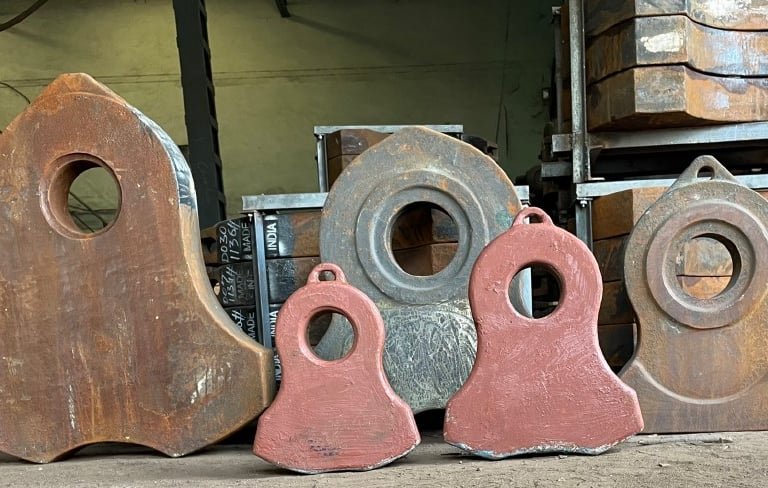
Your New Hammers Are Being Judged by Worn Parts Around Them
A plant fits a new set of hammers and gets noticeably less life than the previous set achieved. The grade is the same, the supplier is the same, the feed has not changed. The conclusion drawn is almost always that quality has slipped — and it is almost always wrong.
Hammers wear fastest, so they get replaced alone. But they do not work alone. The pins, grates, liners and rotor seating around them shape how they wear, and when those are worn the new hammers inherit the problem.
The Symptom That Points Away From the Hammer
One failure mode above all others indicates the machine rather than the metallurgy: eye elongation. The pin hole stretches from round to oval until the hammer must come out, frequently while the striking face still has usable life left.
That is bearing stress at the pin, not abrasion or impact on the face. Changing hammer grade will not fix it. A plant that responds by ordering a tougher or harder hammer will spend money and see the same failure return.
If hammers come out with usable faces but oval eyes, stop looking at the hammer.
Check pin condition, pin material and rotor tolerance first. A metallurgy change cannot correct bearing stress at the pin.
What Each Surrounding Part Does to Hammer Life
- Pins and pin protectors
- Pin protectors exist to be sacrificed so the pins are not. Once they wear through, the pins take direct impact and begin to wear and deform. A worn pin loads the hammer eye unevenly, which produces elongation on a hammer whose face is still sound.
- Grates
- Grates control discharge size. As the bars wear and the openings enlarge, material that should have been discharged stays in the chamber for further strikes. The hammers do more work per tonne of finished product, so wear life falls even though nothing about the hammers changed.
- Liners
- Side and main liners guide how material moves through the chamber. Worn liners change that flow, shifting where material concentrates across the rotor and producing uneven wear between hammer positions.
- Rotor discs and end caps
- These carry and locate the hammers. Wear here means the hammer no longer sits square, which both accelerates eye wear and puts stress into the rotor itself.
- Anvils and breaker bars
- These provide the surface material is struck against. Once worn back, the crushing action changes and the hammers absorb more of the work that the anvil previously shared.
The Compounding Effect
Individually none of these is dramatic. Together they explain why hammer life often declines gradually over several change cycles while everything appears unchanged.
The pattern looks like this. The first set after a full rebuild performs well. The second set, fitted into slightly worn grates and pins, does a little less. The third does less again. By the fourth or fifth cycle the plant is comparing current performance against a figure achieved when the whole machine was fresh, and concluding that the hammers have got worse.
What has actually happened is that the machine has drifted, and the hammers are the only part being renewed.
Uneven Wear Across the Rotor
A second diagnostic worth knowing: if hammers in the same set come out at visibly different states of wear, that is a machine signal, not a casting signal.
A single batch of castings does not vary that much. What varies is where material lands. Feed distribution across the rotor, worn liners channelling material to one side, or seating wear that lets some positions sit differently — any of these produce a set where some hammers are finished and others are half worn.
Ruling this out costs one inspection. Not ruling it out can cost a year of trial orders chasing a metallurgy answer to a mechanical question.
What to Inspect at Every Change-Out
The hammers are already out and the machine is already down. This is the cheapest inspection opportunity you will get:
Any wear through a protector means the pin behind it has been taking direct impact. Measure pins for wear and ovality, not just visible damage.
Compare against original dimensions if you have them. Enlarged openings mean oversize is recirculating and hammers are doing extra work.
Look for wear where hammers locate. A hammer that can move under impact wears its eye faster and stresses the rotor.
Photograph what you find. Over two or three cycles the photographs show drift that a single inspection cannot, and they make the case for a fuller rebuild far easier to justify internally.
When to Replace as a Set
Replacing everything at every change is not the answer either — grates and liners outlast hammers by design. The practical rule is to plan on cycles.
Track how many hammer sets each grate set and each pin set has seen. Once hammer life starts declining without an explanation in the feed, that is the moment to renew the surroundings rather than to change hammer supplier. Quoting the surrounding parts alongside a planned shutdown is nearly always cheaper than an extra hammer change later in the year.
What This Means When Comparing Suppliers
This has a direct commercial consequence. A trial set of hammers fitted into a worn machine will underperform, and the trial will produce a verdict about the supplier that is really a verdict about the grates.
If you are testing a new supplier, fit the trial set after a rebuild or at least record the condition of the surroundings. Otherwise the comparison is not between two suppliers, it is between two states of your own machine.
Send photographs of your worn hammers alongside the pins, grates and seating faces. Our team will tell you whether the wear pattern points to the hammer grade or to the machine around it — and we will say so plainly when the answer is that new hammers are not what you need.
Related Reading
For reading the hammers themselves, see why shredder hammers fail early. For grade selection, see Mn13Cr2 to Mn24Cr2. Products: shredder wear parts including grates, anvils and pin protectors, and shredder hammers.